
Showing posts with label how to. Show all posts
Showing posts with label how to. Show all posts
How to Paint the Mona Lisa
American Gothic, or How to Paint Like Grant Wood

How to Paint Like Pieter Bruegel

While Bruegel's mid 16th century painting style is easy to reproduce as I've done here, this is by far the most complex composition I've painted in quite some time, with so many figures, trees, and buildings. This painting gave me a reason to slow down and realize that paintings can take more than a day to complete. So I took my time and worked back and forth between fore- and background, large areas and details as I saw fit.
All the while I only had to look outside my window during this February storm for snowy inspiration. If my dog were here, we'd be out trudging like these hunters.


Lady with an Ermine, Paint Like Leonardo

How to Paint Like Frans Hals

Frans Hals was the Dutch master of vibrantly painted characters exuding emotion, laughter, inebriation, and such comical facial expressions as the maniacal grimace or sneer that shoots over the shoulder of the Malle Babbe, or "The Witch of Haarlem." That intensely interesting subject is what I have recreated here in a whimsical portrait of a friend who posed.
I love painting Frans Hals copies because of his seemingly quick and loose brushstrokes and the fact that every line and color on his canvases is exactly what is needed in the picture and not a bit more. When I remix his pictures, I keep that looseness and show just the essence of the image instead of a slavish reproduction, while still keeping the spirit of the original. 8x10" canvas board.


It looks like I gave him a falcon instead of an owl, but I imagine this sort of witch/ tavern patron would attract any manner of fowl or rodent. This was a very fun painting, and I have another Hals remix in the works.
How to Paint Like Thomas Gainsborough

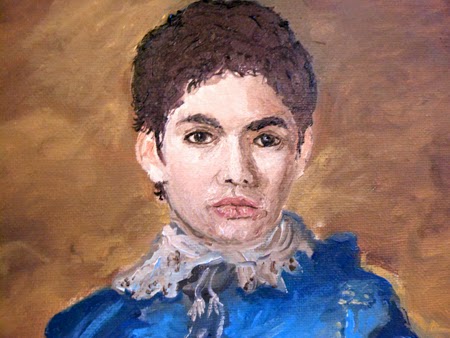
In 1770, Gainsborough took advice from peer Joshua Reynolds who said that blue can not only be the focal point in a painting rather than simply recede, but dominate the canvas. And dominate the Blue Boy does: with that blue satin sheen, the hand on hip and feathered hat, and confident look on the face that assures the viewer 'I'm here, I'm important, and I am worthy of being in one of the best portraits of 18th century Europe'.


How to Paint Like Winslow Homer

Winslow Homer was arguably the most well-known and best of American painters in the 19th century. He painted such masterpieces as Breezing Up (or a Fair Wind), which I have endeavored to replicate for the second time.

How to Paint Like Caravaggio
_-_Saint_John_the_Baptist_-_Google_Art_Project.jpg)
One of the tried and true ways for an artist to learn how to paint is to emulate great artists. This is how I started out with oil painting and it has been invaluable practice. For a while I've been painting my own pictures but it doesn't hurt to get back to the copying, only this time I painted someone else's face, so I've still practiced portraiture and added my own touch.
I've always admired the early Baroque/late Renaissance Italian painter Caravaggio for several reasons. He was considered the first Baroque artist and like any "first", he defied convention and forged his own way, all the while creating controversy and provocation. I hope one day I can blaze a new trail and make valuable new contributions to the world through my art. For now: practice, practice, practice.


Subscribe to:
Posts (Atom)